












.jpg)





Experts predict top security threats to watch out for this year.
When Russia invaded Ukraine in 2022, it wasn’t only the missiles and airstrikes that made headlines. In the lead-up to the invasion, Russia launched an unprecedented cyberattack on more than a dozen Ukrainian government websites. Two years on, it serves as a reminder that modern-day battlegrounds extend far beyond national borders.
“We used to call it the ‘battleground’, but now it’s called the ‘battlespace’,” says Glenn Maiden, director of threat intelligence operations at FortiGuard Labs Australia and New Zealand, the elite threat intelligence and research arm of cybersecurity company, Fortinet.
“In the old days, war was conducted by the air force, army or navy. In the last 30 to 40 years, the domain of warfare has expanded, with cyberspace becoming the fifth domain,” he says. “That means no matter where we are in the world, every single one of us is in the battlespace.”
Tip #1 - You are a target to hackers
Don't ever say, "It won't happen to me." We are all at risk and the stakes are high - both for your personal and financial well-being and for the university's standing and reputation.
- Cybersecurity is everyone's responsibility.
- By following the tips below and remaining vigilant, you are doing your part to protect yourself and others.
Thank you Miss Chloe Oldfield – NGO Developmment and Financial Management Advisor from Volunteer Services Adbroad (VSA).
Miss Chloe Oldfield conducted Xero trainings for Suá ma Pauga Staff earlier this year before she head back to NZ.

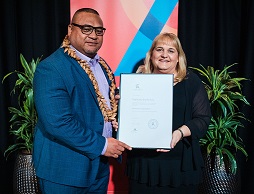
Tagaloa Fa'afouina Su'a inducted in the college of Chartered Accountants (CA) for Chartered Accountant Australia & New Zealand (CAANZ) last night at a ceremony held Cordis Hotel in Auckland CBD.
VAGST THRESHOLD IN SAMOA
All business with sales over $130,000.00 per annum requires registration for VAGST at Ministry for Revenue.
This week marks the issuance of the inaugural IFRS Sustainability Disclosure Standards, designed to provide a global baseline of sustainability-related disclosures for the capital markets.
Better information leads to better economic decisions. IFRS S1 requires companies to communicate the sustainability-risks and opportunities they face over the short, medium, and long term. The requirements are designed to ensure that companies provide investors information relevant to decision-making. IFRS S2 sets out specific climate-related disclosures and is designed to be used with IFRS S1. Both Standards are based on recommendations of the Task Force on Climate-related Financial Disclosures (TCFD).
The concept of understanding an entity’s business model, including how it uses Information Technology (IT) is new in ISA 315 (Revised 2019).
Understanding the business model sounds like child’s play, but in the context of exploring inherent risks, it presents a powerful tool to understand the entity.
Paragraph 19(a)(i) tells us that: The auditor shall perform risk assessment procedures to obtain an understanding of… The entity’s organisational structure, ownership and governance, and its business model, including the extent to which the business model integrates the use of IT.
Paragraph A61 explains why this is necessary.
In the post-pandemic era, accounting professionals will need to transform their skill set, with new tools and a new way of thinking about client service
As the pandemic and what comes after continues to transform the accounting profession, CPAs need a new mindset, skill set, and tool set to thrive, says Tom Hood, executive vice president of the Association of International Certified Professional Accountants (AICPA).
Hood recently spoke with the Thomson Reuters Institute about the future of the accounting profession in the post-pandemic era — a theme he addressed in a presentation at AICPA’s recent 2021 ENGAGE conference and in a whitepaper and course from the Business Learning Institute.
When the COVID-19 pandemic shut down the global economy in early 2020, accountants were deemed essential workers because of their important role in sustaining business operations, tax collection, and the overall economy, Hood notes. In the months that followed, many accounting firms helped their business clients navigate unprecedented business challenges and leverage federal relief packages, including the Paycheck Protection Program and Economic Injury Disaster Loan program.
“CPAs had to immediately shift from preparing taxes to consulting on these things,” Hood says. “Through that period until now, $7 trillion went through accounting, tax, and payroll systems, because those systems administered the relief. That’s why the profession was declared essential.”
 Tom Hood, executive VP of AICPA
by David Edgerton APV
Introduction
With the recent publication of IPSASBs new standards on Infrastructure and Measurement, it is appropriate to summarise the key changes from the old IPSAS17 Property Plant and Equipment and reflect on how the new IPSAS requirements differ from the existing IFRS valuation requirements. While there is a conceptual difference with IPSAS being an ‘entity specific entry price’ and IFRS being an ‘exit price at highest and best use’, in reality, almost of all of the requirements once the replacement cost of market value is determined are the same. This includes disclosures and the calculation of depreciation expense. read more Full PDF article >>
By David Edgerton APV
Historical Inconsistencies
Since the implementation of accrual accounting in the public sector there has been significant inconsistencies regarding the interpretation and association application of a range of valuation related aspects of the IFRS and IPSAS standards.
For example, in Australia, over the past 20 years the level of inconsistency has been exacerbated as a number of jurisdictions mandating the revaluation model for the first time and issuing guidance which was not consistent with practices adopted in other jurisdictions or jurisdictions had not updated their guidance despite significant changes in the accounting standards. read more Full PDF Article>>
Pacific Island Countries
Depending on whether and entity is a government department or agency or government owned enterprise, some pacific island countries adopt the IFRS standards (as done in Australia across all sectors) while others follow the IPSAS standards. read more Full PDF Article>>
Page 3 of 6
- You are here:
-
Home

- News